Why AI Literacy is Vital for Schoolchildren in 2026
In a world transformed by artificial intelligence, preparing South African learners with AI literacy is no longer a futuristic idea, it's a present-day necessity.
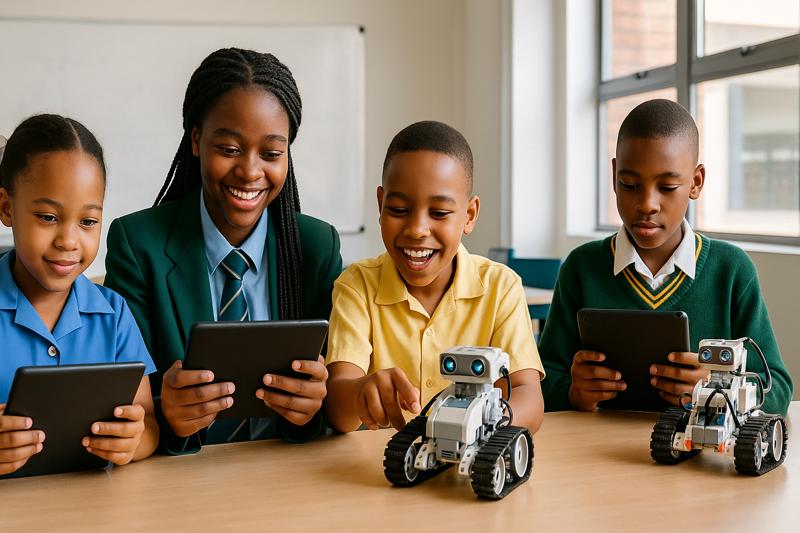
Picture a Grade 6 classroom in 2026. A learner is speaking to an AI assistant on a tablet, asking for help with a tricky maths concept. Another learner sits nearby, building a small robot using a starter kit. Hundreds of kilometers away, a passionate teacher in a rural school is drawing coding symbols on a chalkboard because the internet is down again. Her learners are still excited. They may not have fibre or smart screens, but they know the world is changing and they want to be part of it.
These scenes are not from a science fiction movie. They are glimpses of the South Africa that is unfolding around us. Artificial intelligence has moved out of labs and tech companies and into our homes, phones, classrooms, and daily conversations. AI literacy is no longer something to consider later. It has become as important as reading or basic numeracy.
This article is written for educators, parents, principals, district leaders, and anyone who cares about the future of young South Africans. It explains why AI literacy matters right now and why 2026 is a pivotal year for shaping how our children grow and succeed in a world of intelligent technology.
AI Has Arrived in the Classroom
Just a few short years ago, AI was treated as a futuristic idea that belonged to Silicon Valley. Today, schoolchildren can use AI to generate stories, translate languages, solve science questions, create art, or practice multiplication. Many already do. Apps like ChatGPT, Grammarly, Photomath, and Socratic are used daily without most adults even realizing it.
AI literacy is not the same thing as using an app. It goes deeper. It includes knowing what an algorithm is, how AI systems learn, and how to question the output of a chatbot. It includes evaluating whether AI content is true or false. It includes understanding how AI affects society and how to use it responsibly and ethically.
In a world full of deepfakes, misinformation, and automated influence, children who understand AI have a huge advantage. They will become smarter digital citizens and critical thinkers. AI literacy is becoming a new foundational skill. It joins reading, writing, numeracy, and digital skills as a central pillar of modern education.
South Africa’s Leap: The Coding and Robotics Curriculum
To its credit, South Africa has already begun preparing for this future. The Department of Basic Education created the official Coding and Robotics curriculum for Grades R to 9. It was gazetted in 2024. This curriculum introduces children not only to coding, but also to key emerging technologies including artificial intelligence, machine learning, virtual and augmented reality, and the Internet of Things.
This curriculum supports problem solving, computational thinking, creativity, and foundational logic. It aligns with global skills requirements and seeks to prepare children for careers that do not yet exist.
The rollout, however, is not immediate. The DBE’s plan is to introduce the curriculum gradually. Schools with capacity and resources will begin first. Others will follow as infrastructure and teacher training improve. This approach acknowledges reality. It acknowledges that South Africa must protect core literacy and numeracy skills first, rather than rushing into advanced content without proper foundations.
However, beginning with the early grades is a smart choice. Young children are being introduced to coding logic using unplugged methods. Instead of screens, they use cards, movement games, blocks, and stories to learn key concepts like loops, sequences, and patterns. This ensures that even children in schools without computers can begin developing the mental framework needed for coding and AI.
It proves something powerful. Being a future focused school does not always require an expensive computer lab. It requires intention, creativity, and supportive leadership.
The Digital Divide Is Still a Hard Reality
The new curriculum excites many of us. Yet it brings us back to a painful truth. The digital divide in South Africa is wide and deeply rooted. Roughly 85 percent of schools are under resourced. Many have no internet access. Some have no devices. Some do not even have electricity they can count on. There is also a shortage of more than 30 000 teachers in the system, with even fewer trained to teach AI related subjects.
Teacher confidence is low. Research shows that only about one in five teachers feel prepared to use AI tools or teach coding. That is not due to lack of willingness. It is due to lack of tools, training, and time.
We also cannot forget what happened during the pandemic. When learning moved online, hundreds of thousands of learners fell behind or dropped out altogether. Not because they lacked ability, but because they lacked data, devices, and access. Some families still pay extremely high rates for prepaid cellular data compared to households with fibre internet. Poverty becomes a barrier to learning.
If AI literacy becomes something only well funded schools can teach, then technology will strengthen inequality instead of reducing it. We will create a world in which privileged learners initiate machine learning projects, while others have never touched a computer.
That outcome is not acceptable.
We must make AI literacy accessible and affordable. We need investment in teacher training programs, device access, school connectivity initiatives, and public policy that prioritizes digital equity. If we treat AI literacy as a human right rather than a luxury, we will change the course of millions of young lives.
AI Fluency and the Future of Work
Children entering primary school right now will grow up in a world where AI is built into almost every job. Future careers will require knowledge of digital systems and automated tools. The World Economic Forum lists AI and machine learning specialists, robotics engineers, data analysts, cybersecurity experts, and digital product managers among the fastest growing jobs in South Africa and worldwide.
The ability to work with AI will not be reserved for programmers. A nurse will use AI clinical decision support tools. A lawyer will work with AI assisted case research. A farmer will use AI sensors to manage crops. A retailer will use AI demand forecasting to stock shelves. A content creator will use AI animation tools. Everyone will interact with intelligent systems.
This is why AI literacy matters. It prepares children not just for specific careers, but for a world where technology is integrated into everything. It cultivates creativity, critical thinking, digital judgment, curiosity, and adaptability. In fact, adaptability might be the most important skill of all. Most of the jobs our children will do do not exist yet. They need to know how to learn, how to experiment, and how to master new tools.
If we do not give them this foundation, we are building a future of unemployment, frustration, and inequality. If we empower them early, we unlock a future of innovation, entrepreneurship, and shared prosperity.
Real South African Examples That Inspire Hope
There are already powerful stories in South Africa that show what happens when children are given a chance to explore AI and robotics.
Carnarvon High School in the Northern Cape is one such example. With support from the South African Radio Astronomy Observatory, learners in a rural area joined a robotics program and eventually qualified for the World Robot Olympiad in Slovenia. For many of them, it was their first time on an airplane and their first time leaving the country. They came back not just with medals, but with new dreams.
One learner said that she never believed someone from her rural town could work in engineering. The exposure changed her idea of what is possible.
That is the power of access. When children are exposed to AI and robotics, their confidence grows. Their ambitions expand. They start imagining futures that were once invisible to them.
Local Solutions Are Already Emerging
South Africa is not waiting for change to arrive from outside. Communities, NGOs, and entrepreneurs are building the future right here.
Platforms like AIExplorers offer multimodal AI learning content for primary and high school learners. Schools can subscribe and get ready to use lessons, quizzes, voice-based explanations, and interactive content that makes AI understandable and fun. Other coding clubs, nonprofit initiatives, and STEM programs are helping teachers and learners access basic robotics, coding games, and AI challenges.
These programs do not require advanced resources. They simply require the will to begin.
AI literacy is not about turning every child into a software developer. It is about helping every child understand the tools that shape their world. Whether they explore AI through a coding game, a robotics project, a creative writing assignment using an AI assist tool, or a discussion about ethics and bias, they are building essential understanding.
A National Call to Action
We stand at a turning point. We can empower an entire generation by embracing AI literacy, or we can lose them to a world they do not understand.
So what should we do?
Teachers
Start small. Use low tech methods if needed. Talk openly about how AI systems work. Experiment with free tools. Share resources with other teachers.
Parents
Encourage your children to explore technology. Let them teach you what they learn. Provide access to free or low cost online tools. Advocate for better digital resources at school.
Principals and policymakers
Prioritize AI literacy in your school development plans. Request budget allocations. Partner with organizations who can support implementation. Give teachers training time and support.
Businesses, universities, and community leaders
Provide mentorship, sponsorships, kits, devices, or internships. Help schools make real industry connections.
The Final Word
The year 2026 is not some far away milestone. It is already here. The children in front of us are already engaging with AI without guidance. They are growing up in a world of algorithms, personalized feeds, chatbots, and automation. We cannot ignore the need for AI literacy. We cannot hope it works out on its own.
We must teach them to understand these systems, not fear them. To use them, not be controlled by them. To innovate with ethics, not consume blindly. To create, imagine, challenge, and build.
South Africa has the opportunity to become an AI empowered nation that remains deeply human. A nation that uses technology to uplift rather than to divide. A nation where the spirit of Ubuntu meets the intelligence of our time.
The future belongs to those who understand it. Let us make sure our children do.